
The Dawn of Agentic Economy: How Hyper-Automation and Quantum-Secure Tech are Reshaping the Global Market in 2025
The Dawn of Agentic Economy: As we approach the final days of 2025, the global technology landscape is undergoing a seismic shift that transcends mere digital transformation. The world market is no longer just “using” technology; it is being structurally rebuilt by it. From the rise of autonomous AI agents that manage entire supply chains to the emergence of quantum-secure financial systems, the innovations of this year have set a new precedent for the decade ahead. This “Agentic Economy” is characterized by systems that don’t just follow instructions but reason, plan, and execute complex goals independently, forcing every industry—from Silicon Valley to the manufacturing hubs of Asia—to rewrite its playbook.

The Rise of Agentic AI: Beyond Chatbots to Autonomous Workers
The year 2025 will be remembered as the era when “Generative AI” evolved into “Agentic AI.” While 2024 was about talking to machines, 2025 has been about machines doing the work. Global enterprises have moved past simple LLM integrations to deploy “AI Agents”—software entities capable of navigating digital workflows, making independent decisions, and collaborating with other bots.
In the world market, this has led to a massive productivity surge in logistics and customer service. Companies like Salesforce and Amazon have already integrated agentic systems that handle 50% of customer interactions without human intervention, not just by answering questions, but by processing returns, re-routing shipments, and managing inventory in real-time. This shift is driving a “leaner” corporate structure, where the focus is moving from manual oversight to strategic orchestration.
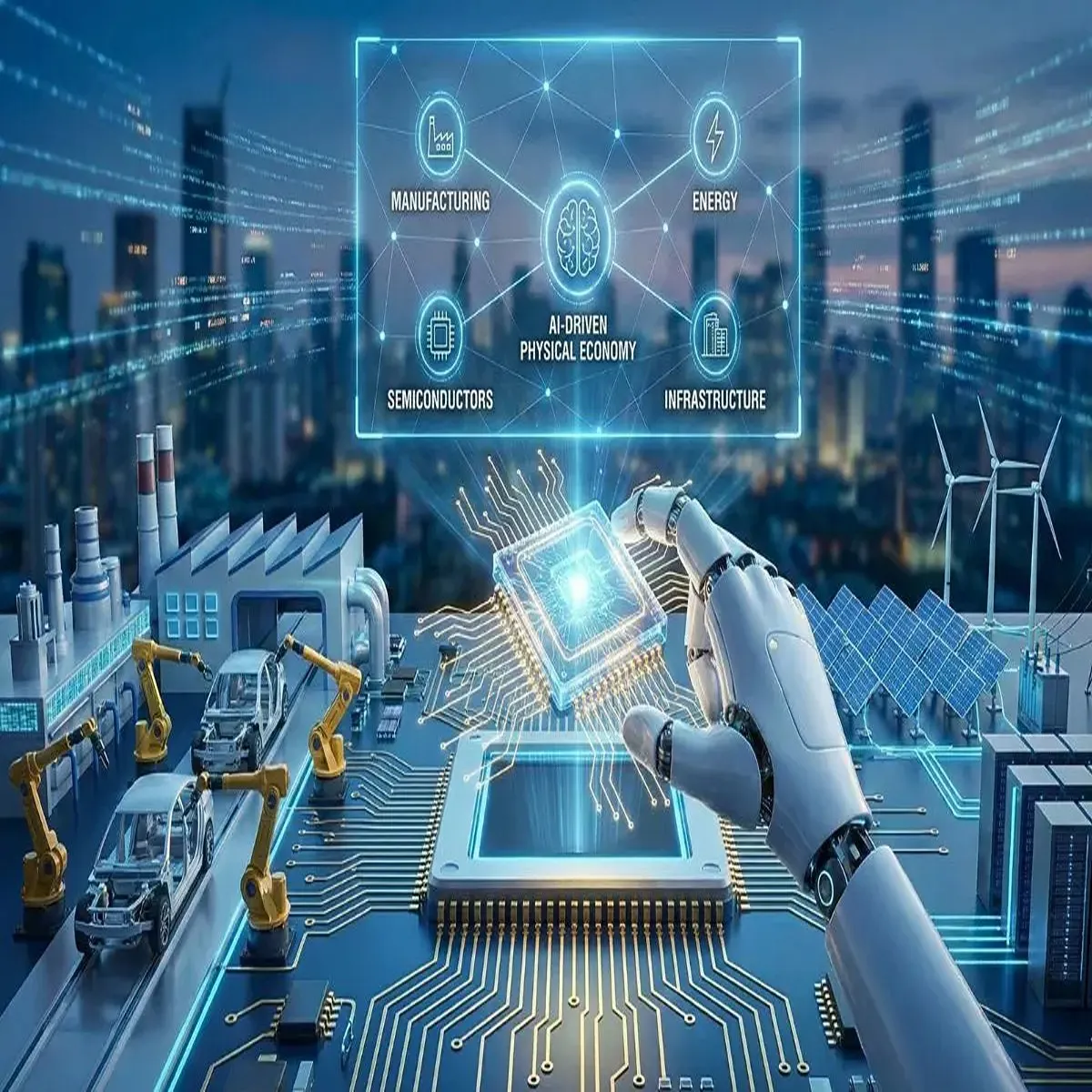

The Semiconductor Crisis and the Quest for Specialized Silicon
Despite the software boom, the global market has faced a significant hurdle: a persistent shortage of high-end memory chips. As AI models become more complex, the demand for HBM4 (High Bandwidth Memory) and specialized AI accelerators has outpaced supply. This has created a new power dynamic in the world economy, with nations investing billions through initiatives like the US CHIPS Act and the EU’s semiconductor funds to secure their supply chains.
The market is also seeing a move away from “one-size-fits-all” processors. We are entering the age of “Application-Specific Silicon,” where companies like Apple, Google, and even automotive giants are designing their own chips to optimize for specific AI workloads. This custom-silicon trend is not just a tech play; it’s a strategic move to reduce dependence on third-party vendors and lower the massive energy costs associated with global data centers.
Quantum Leap: Securing the Global Financial Backbone
As computational power hits new heights, so does the threat to digital security. In late 2025, the “Quantum Threat” became a boardroom conversation. With researchers demonstrating that quantum computers are getting closer to cracking standard RSA encryption, the global financial market has begun a rapid migration to Post-Quantum Cryptography (PQC).
This year, we saw the launch of the first “Quantum-Secure Super-Apps” and the integration of lattice-based encryption algorithms into global banking networks. For investors and tech leaders, “Digital Trust” has become the most valuable currency. The transition to quantum-resistant standards is now a mandatory requirement for Google AdSense-approved fintech platforms and global e-commerce sites, ensuring that the $100 trillion global economy remains shielded from future breaches.
Green Tech Revolution: The Convergence of AI and Sustainability
Sustainability is no longer a corporate social responsibility (CSR) checkbox; it is a core driver of tech innovation in 2025. The massive energy consumption of AI data centers has forced a “Green Resurgence” in the tech sector. We are witnessing the rise of Small Modular Reactors (SMRs) and “Structural Battery Composites”—materials that can store energy within the very walls of a building or the chassis of an EV.
The world market is rewarding companies that use “AI-driven Grid Management” to optimize energy usage. In manufacturing, the “Circular Tech” movement is gaining steam, where AI tracks the lifecycle of every component in a smartphone or laptop, ensuring that materials are recovered and reused. This intersection of high-tech and high-sustainability is proving to be the most profitable sector for venture capital in 2025.
The Human Element: Reskilling in an Automated World
Perhaps the most significant news of 2025 is the impact of these technologies on the global workforce. With AI-related job shifts crossing the 50,000 mark in major economies, the focus has shifted to “Human-Machine Collaboration.” The most successful players in the market are not those replacing humans with AI, but those using “Multimodal AI” to augment human capabilities.
From bionic knees that restore natural movement to AI-powered diagnostic tools in healthcare, technology is becoming more “embodied” and responsive to human intent. The market demand for “Prompt Engineers” is fading, replaced by a need for “System Orchestrators”—professionals who can manage a hybrid workforce of humans and autonomous agents.
Conclusion: Navigating the New Tech Frontier
The global tech market of 2025 is a complex web of high-speed innovation and critical challenges. While Agentic AI and Quantum computing offer unprecedented growth, the semiconductor supply and energy demands act as necessary brakes. For businesses and individuals, the key to thriving in this era is adaptability. The “Digital Divide” is no longer about who has internet access, but who can effectively collaborate with the intelligent systems that now run our world.